
Maine
Paid Family and Medical Leave
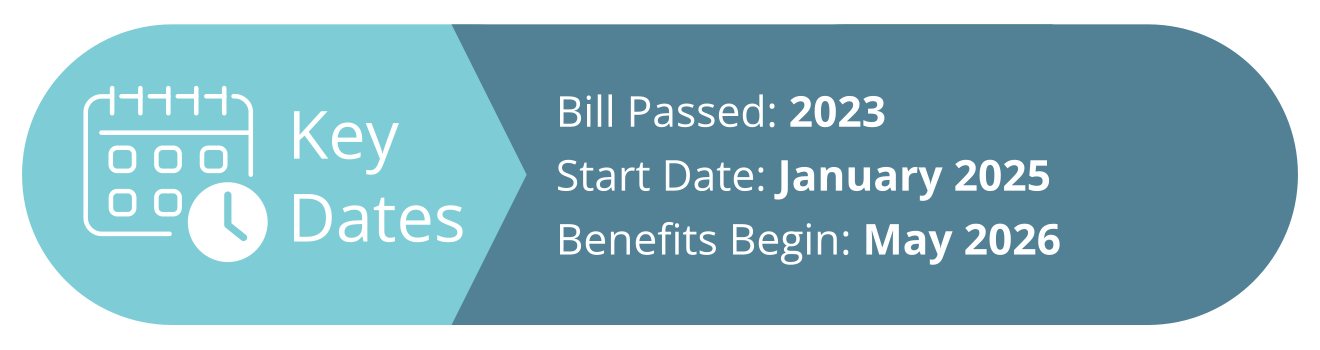
Use these resources to help you better understand Maine's PFML program.
Who is Covered?
Employers
Covered
- Nearly all employers, including private-sector employers, state and local governments, state colleges and universities, public schools and charter schools
Not Covered
- Federal government employers
- Employers with fewer than 15 employees do not have to contribute toward the payroll tax but must still collect and remit the employee portion
- Self-employed individuals, independent contractors
Employees
Covered
- Nearly all employees, including those employed by private employers, state and local government employers, state colleges and universities, public and charter schools
- Employees must earn and submit premium on at least 6 times the state's average weekly wage in the previous 4 calendar quarters
Not Covered
- Federal government employees
- Self-employed individuals, but may opt in
- Independent contractors, but may opt in
- Tribal governments that have not elected coverage
Types of Leave

Family
Leave to care for a family member who has a serious health condition
Definition:
“Family member” includes the employee’s child; parent or legal guardian; sibling; grandchild; grandparent; grandchild; sibling; spouse or domestic partner; and an individual with a “significant personal bond that is or is like a family relationship” as designated by the employee. This definition is not limited to biological relationships.

Medical
Leave for an employee's own serious health condition, including medical care related to pregnancy and to bond with an employee’s child within 12 months of birth, adoption, or foster care placement
For the donation of an organ of the employee for a human organ transplant

Military
Leave to address a serious health condition of a family member who is a covered service member or for a qualifying need arising out of a family member’s active-duty service or notice of an impending call or order to active duty in the United States Armed Forces

Safe
Leave taken because the employee or the employee's family member is a victim of violence, assault, sexual assault, stalking, or any act which supports a need for an order of protection
An employee may take up to 12 weeks of paid family and medical leave (also including military and safe leave) in the aggregate per year.
 |
Benefit Amount: 90% of the employee’s average weekly wage (AWW) for the portion of wages that is equal to or less than 50% of the state average weekly wage (SAWW), and 66% of the employee’s AWW that exceeds 50% of the SAWW, subject to the maximum weekly benefit Maximum weekly benefit capped at 100% SAWW until 2026 A seven day, unpaid waiting period applies for medical leave. |
Things to Consider
Are employers prepared to manage the additional administrative tasks associated with these types of plans?
- How will employers manage the possible increase in the number of employees out on leave?
- Will employers have the ability to provide an adequate workforce to account for employees who are on leave?
- How will the new plan integrate with sick leave, sick leave banks, sick leave donations, etc.?
How will this impact retention/recruitment?
- How will employers preserve the value of employer-provided benefit plans as a differentiator?
- Will it be necessary to offer supplemental benefits to fill potential holes in PFML coverage (waiting periods, long-term disability, etc.)?